End-of-Life Conversations: 4 Key Questions Answered
1517 0
A post written by Associate Professor Kim Devery, End-of-Life Essentials
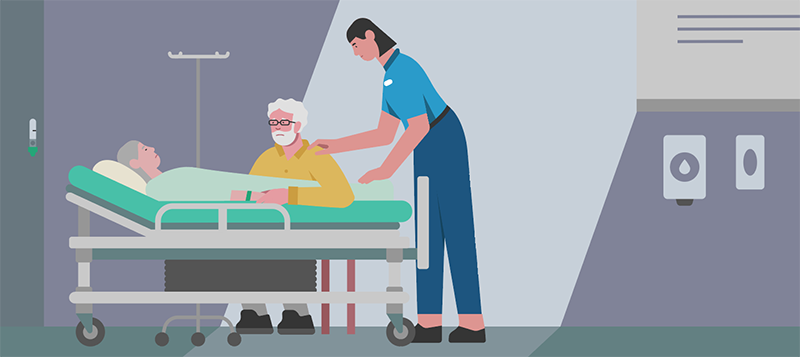
In the End-of-Life Essentials Communication Masterclass webinar, Kim Devery led a panel of palliative care experts who shared their experiences, insights, and strategies for end-of-life conversations.
Here Kim answers questions from webinar participants:
1. I had a patient who continued asking difficult questions and becoming quite distressed during these conversations. They couldn't recall these conversations and would ask again, becoming distressed. A very nasty cycle! How would you advise managing this situation with the aim of making the patient as comfortable as possible?
Focus on limiting their distress. At times discussing end-of-life issues may be distressing for patients and staff. Sometimes patients with good cognitive function ask the same questions and go through phases of high emotion. It’s difficult to generalise here in answering this question. It has been said that clinicians who work in end-of-life care need a high tolerance for emotional distress, complexity, and ambiguity.
Some questions to ask yourself are:
- What challenged you about the questions? Was it the repetition? The patient’s emotion?
- How comfortable are you when sitting with a patient’s distress? If you had concerns about the needs of the patient and felt that a social worker or pastoral care may assist, then referral would be a sensible move.
2. What are some practical things that you offer people that provide the most assistance? E.g. in a hospital we'll often offer a larger room so their family can stay, or tell people to bring their own pillows in. Would love some more ideas that I've not thought of.
Think of the fundamentals.
Does your hospital offer discounted parking for families? If not, can you suggest that this type of discount could be arranged?
What about involving the family in patient care (hand or foot rub, mouth care for example).
How are the family managing? Research evidence is growing that shows that bereavement outcomes for families and friends are linked to shared decision-making, communication and support from health care teams.[1]
Here is what you can do:
3. As nurses, doctors & allied health practitioners, what are the distinct needs, expectations you have observed among patients/families from multicultural & collectivist backgrounds - compared to mainstream populations.
In thinking about this question, it strikes me that it’s difficult to define ‘mainstream’ in Australia today. But certainly, issues of disclosure of prognosis and a celebration of community rather than individual preferences, for example, can be found more often in diverse communities.
As health care professionals we need to be aware that patients and families may or may not have different values and preferences to those we hold close. The very power imbalance of providing health care as opposed to receiving care can have potential to amplify power imbalances.
We have a whole module on End-of-Life Care for Diverse Populations, containing helpful case studies, that we’d highly recommend to you.
4. How do you answer the question from family around how long a patient has left to live/should someone come home from overseas early? I had a strong feeling death of their loved one was possibly within 24hrs. But obviously I could be wrong. After the resident died, I agonised about whether I should have told the family more. What are your recommendations?
Yes, try not to agonise. End-of-life care is full of ambiguity and uncertainty, and we need to incorporate those concepts when we communicate with families.
Something like:
"I’m really pleased you asked me, I wish I could be more certain, but we are not very accurate at estimating length of life, the timing of death or prognosis. Every health care professional would have a different response.
What is certain is that your Mum is sick enough to die soon. That could be weeks (or days or months – make an estimation). I wish I could give you a better answer. It could be sooner or a bit later. The main thing you need to think of for your self is if you want to see your Mum, come sooner."
Read more in the End-of-Life Essentials document Discussing the future and prognosis (218kb pdf).
References
[1] Sadler E, Hales B, Henry B, Xiong W, Myers J, Wynnychuk L, et al. Factors affecting family satisfaction with inpatient end-of-life care. PloS one. 2014 Nov 17;9(11):e110860.
Associate Professor Kim Devery