


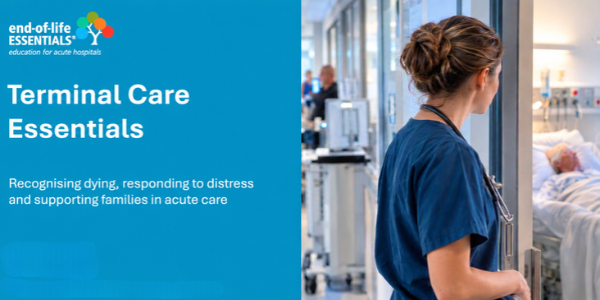
More than 900 health professionals registered to the End-of-Life Essentials' Terminal Care Essentials webinar to explore one of the most important and challenging aspects of healthcare: caring for people in the final hours and days of life.
Facilitated by Dr Claudia Virdun, specialist palliative care nurse, researcher and Co-Lead of End-of-Life Essentials, the webinar brought together three experienced clinicians who shared practical insights from years of caring for people with life-limiting illness across hospital, community, and specialist palliative care settings.
The discussion was framed around four essential questions faced by clinicians every day:
- How do we assess what is happening and recognise when someone may be dying?
- How do we provide effective terminal care?
- How do we communicate uncertainty honestly and compassionately?
- How do we support families through one of the most significant experiences of their lives?
As Claudia reflected, caring for people who are dying is core business for health professionals.
While it can feel confronting, particularly for those early in their careers, high-quality terminal care can profoundly influence patient comfort, family experiences and bereavement outcomes, and clinician wellbeing.
Assess: Recognising When a Person May Be Dying
For Jeanette Lacey, End-of-Life Care Nurse Practitioner at John Hunter Hospital, one of the greatest challenges in acute care is recognising when a person is entering the final stage of life.
Unlike clinicians in community or residential aged care settings, hospital staff often meet patients during periods of crisis and may know little about who they were before admission.
Jeanette encouraged clinicians to become ‘detectives’, looking beyond the immediate problem and considering the person's overall illness trajectory. Increasing dependence, spending more time in bed, reduced oral intake, difficulties swallowing, and decreased engagement can all provide important clues that a person may be approaching the end of life.
Importantly, recognising dying is not about accurately predicting the exact timing of death. Rather, it is about understanding what matters most to the person and ensuring care aligns with their goals, values and preferences.
‘What we really need to be doing as clinicians is sitting down and thinking, what does this person want?’ Jeanette Lacey
Jeanette also highlighted the importance of speaking up when concerns arise. For less experienced clinicians, uncertainty can sometimes feel like a barrier to action. Instead, she advocated for curiosity and collaboration.
‘I'm really worried that John might be dying. And I'm wondering if together we could go and have a look at John and talk about what this might mean for him.’ Jeanette Lacey
The message was reassuringly simple: clinicians don't need all the answers. They simply need the confidence to notice, question and advocate.
Care: Looking Beyond Symptoms
Professor Leeroy William, Head of Palliative Care at South West Healthcare, explored how clinicians can provide effective terminal care by understanding the many factors that contribute to distress at the end of life.
While agitation, restlessness or discomfort may occur during the dying process, Leeroy cautioned against assuming every symptom is an inevitable part of dying.
Distress can have physical, psychological, social and spiritual causes, many of which may be reversible or manageable. Urinary retention, constipation, environmental stressors, medication effects, fear, family dynamics and unresolved emotional concerns may all contribute to a person's experience.
For Leeroy, effective care begins with understanding the individual.
‘The story of the person really tells me about how I'm going to approach the distress they might have at the end of life.’
Families often play a crucial role in this assessment, helping clinicians understand who the person is, how they have coped throughout life and what might be most important to them now.
The discussion also addressed terminal respiratory secretions, sometimes referred to as the ‘death rattle’, a symptom that commonly causes distress for families. Leeroy explained that education and reassurance are often as important as clinical interventions.
‘We often describe it as a bit like snoring. The person who's snoring is unaware and usually oblivious to what's happening, whereas the person next to them is much more troubled by it.’
By combining careful assessment, symptom management and clear communication, clinicians can help create greater comfort and reduce anxiety for both patients and families.
Communicate and Support: Helping Families Through Uncertainty
For palliative care Nurse Practitioner and Senior Lecturer Joshua Cohen, communication sits at the heart of high-quality terminal care. His reflections focused not only on supporting families, but also on helping clinicians become more comfortable with the uncertainty that often accompanies dying.
Joshua introduced the concept of ‘liminal personhood', describing the space between life and death where a person's ability to communicate, interact and make decisions may fluctuate significantly. During this time, families become essential partners in care.
‘The family hold the identity of that person.’
Through conversations with loved ones, clinicians can better understand a person's values, preferences and life story, helping to preserve personhood even when communication becomes difficult.
Joshua also highlighted one of the most valuable contributions healthcare professionals can make: preparing families for what they may witness.
‘Even the novices (health care professionals) have probably seen more deaths than the family or people present in that room today. And that information is gold for families.’
Explaining changes in breathing patterns, reduced appetite, altered consciousness and other signs of deterioration can reduce fear and help families feel less alone.
Families often look to healthcare professionals for guidance about what they should be doing as death approaches. One question that frequently arises is whether it is okay to leave the bedside, even briefly.
Joshua encouraged clinicians to reassure families that there is no single ‘right’ way to be present during this time.
‘This is an incredibly personal choice. The choices that I made and will make will be different to your choices, but they're all okay.’
By normalising different responses and preferences, clinicians can help relieve feelings of guilt or anxiety and support families to make the choices that feel right for them.
When reflecting on what had helped him become more comfortable providing terminal care, Joshua offered perhaps the most powerful insight from the discussion:
‘I think the comfort came from communication, from sitting in uncertainty and being comfortable with that, but also telling families, 'I'm not sure what's going to happen. I don't have all the answers, but whilst I'm here, you'll have my attention and I'll be available and responsive.'‘
It was a reminder that families do not necessarily need certainty. What they need is honesty, presence and support.
Presence Matters
As the webinar concluded, panelists reflected on the lessons they wished someone had taught them earlier in their careers. Their responses returned to a theme that had been present throughout the discussion: the importance of simply being there.
Jeanette reflected on the value of presence and silence.
‘The beautiful thing that you can give a family, and a dying patient, is your presence and sometimes your absolute silence.’
Joshua spoke about the privilege of being invited into some of life's most intimate moments.
‘Being there is amazing…and no two deaths are the same. I believe families take those moments with them as well.’
For Leeroy, one of the most important lessons has been understanding the role clinicians play in creating a sense of safety at the end of life. Whether caring for someone over many months or meeting them only in their final days, healthcare professionals can help patients and families feel safe through reassurance, information and compassionate communication.
For clinicians working in busy healthcare environments, terminal care can sometimes feel overshadowed by competing priorities and uncertainty. Yet as this webinar demonstrated, recognising dying, managing distress, communicating honestly and supporting families are some of the most important contributions healthcare professionals can make.
Learn More
End-of-Life Essentials offers free evidence-based education modules, practical resources and implementation tools designed to support clinicians caring for people at the end of life.
To further develop your knowledge and confidence in terminal care, learn more in the
- Imminent Death and
- Communication and Decision-Making modules.
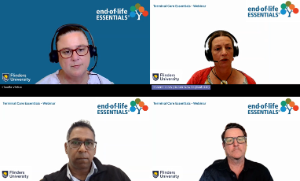
Top L - Dr Claudia Virdun; Top R - Jeanette Lacey;
Bottom L - Professor Leeroy William; Bottom R - Joshua Cohen